December 2025
On December 12, 1941—five days after the Japanese surprise attack on Pearl Harbor—Hitler gathered his top enforcers for a closed-door meeting. What he said that day removed any doubt about Nazi intentions: the war, he declared, now required the “extermination of the Jews.”
In the years leading up to that moment, dehumanizing rhetoric, antisemitic decrees, and violence had, step by step, been woven into law, culture, and the everyday life of Germany. Once the war had begun, ideology became fused with barbarity, and by late 1941 the machinery of mass murder had transformed into genocide.
December 12 reminds us how words can turn into actions—especially when societies grow numb to the language of hate.
Why Our Work Matters. Now.
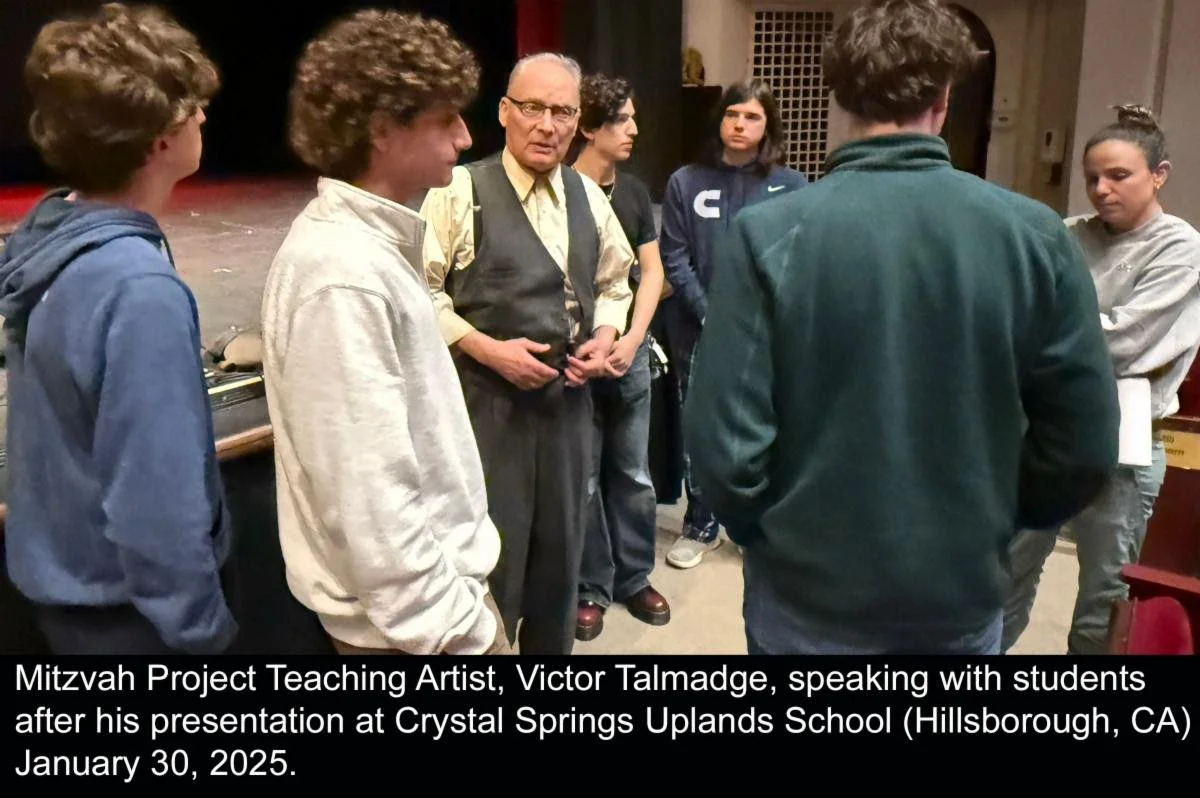
Today’s students are coming of age in a world marked by polarization, disinformation, and a climate in which hateful and degrading language has become normalized. Many young people lack the historical grounding to recognize what happens when societal norms erode in a democracy.
By leveraging the power of theater and the lessons of history, The Mitzvah Project’s teaching artists give students tools to help them:
recognize how words and images can be used to mislead or divide.
understand how ordinary people can be drawn into extremism.
see that their choices—and their voices—matter.
Our Reach: Real Schools, Real Students, Real Impact
In 2026, several thousand students across the country will experience The Mitzvah Project, including first-time presentations at:
Lynnwood High School — Bothell, Washington
Girls Academic Leadership Academy (“GALA”) — Los Angeles, California
James Logan High School — Union City, California (2 back-to-back presentations over 2 days)
Bountiful High School — Bountiful, Utah
Salt Lake Center for Science Education — Salt Lake City, Utah
Across these varied communities, our teaching artists help students grasp not only what happened during the Holocaust, but how democratic norms can slowly disappear allowing hatred to harden into policy.
Our Next Milestone: The January 2027 Revival of I Died in Auschwitz
Alongside our Holocaust education program, we are preparing for the January 2027 revival of I Died in Auschwitz at the Marin Shakespeare Company.
More than a remembrance, I Died in Auschwitz is a powerful solo drama that weaves together the voices of a Polish-Jewish survivor, a half-Jewish German officer, a merciless and unrepentant SS General, and a sardonic American-Jewish comedian (the “Chorus.”).
At its center is Schmuel Berkowicz, the Polish Jew whose survival and testimony reveal both the brutality he endured and the humanity he refused to surrender—even as he comforts Christoph Rosenberg, the half-Jewish First Lieutenant tortured for defying the Nazis.
The production will feature student matinees and post-show discussions and serve as the springboard to a national tour.
Looking Ahead
In 2026, The Mitzvah Project will expand into communities that have never experienced our work, while I Died in Auschwitz builds toward its 2027 revival and future engagements across the country.
Your support will help make all of this possible.
The Mitzvah Project is a fiscally sponsored program of PlayGround (Federal ID 94-3336399), a California 501(c)(3) nonprofit organization. All donations are tax-deductible as allowed by law.
To donate by mail: Send checks payable to PlayGround (add “The Mitzvah Project” in the memo section) and mail to:
PlayGround
3286 Adeline Street #8
Berkeley, CA 94703-2485
PlayGround (Federal ID 94-3336399), a California not-for-profit corporation, is The Mitzvah Project’s fiscal sponsor.
All donations are tax-deductible to the extent allowed by law.
Happy holidays and my best wishes for the new year,

Roger Grunwald, Founder, The Mitzvah Project
————————————————————————————-
P.S. In the next newsletter, watch for news about the upcoming Bay Area theater production of I Died in Auschwitz. In meantime, click on the I Died in Auschwitz logo (below) to read about the play:
"The Enduring Relevance of I Died in Auschwitz in Today’s World."